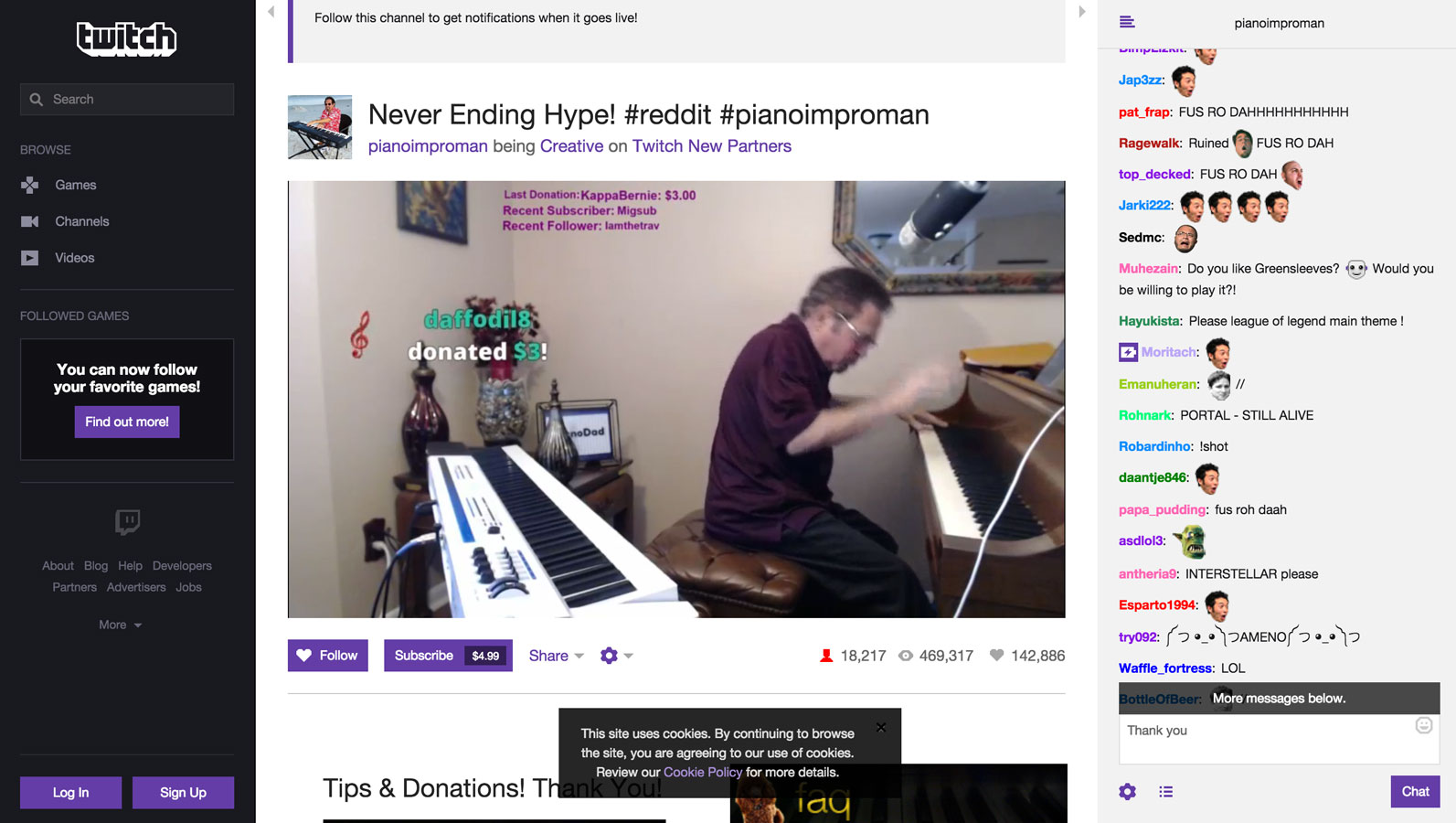
Piano improv on Twitch - Bernie is currently playing in front of a Madison Square Garden size audience. 20, 000 and growing. It is mad and absolutely amazing by mirena

Piano Improv on Twitch in front of 18,200 people The Favorites:

http://imgur.com/gallery/i7ELPwQ

Twitch:

http://www.twitch.tv/pianoimproman

I recently saw the excellent Danny Boyle movie Steve Jobs and in the movie Jobs predicted that the computer is going to be like a bicycle for the mind. Joseph Campbell said that everyone is a hero at birth.  And here I am in front of my treasured Mac, enjoying the work of a musical hero in front of his piano, related to me via his computer. The audience is currently at 20, 000, larger than Madison Square Garden. What an awesome time to be alive.

( just found out he had 65, 000 simultaneous viewers yesterday, so yeah )

Star Wars - Cantina - http://www.twitch.tv/pianoimproman/v/37799456?t=05h38m35s

Thanks to reddit.

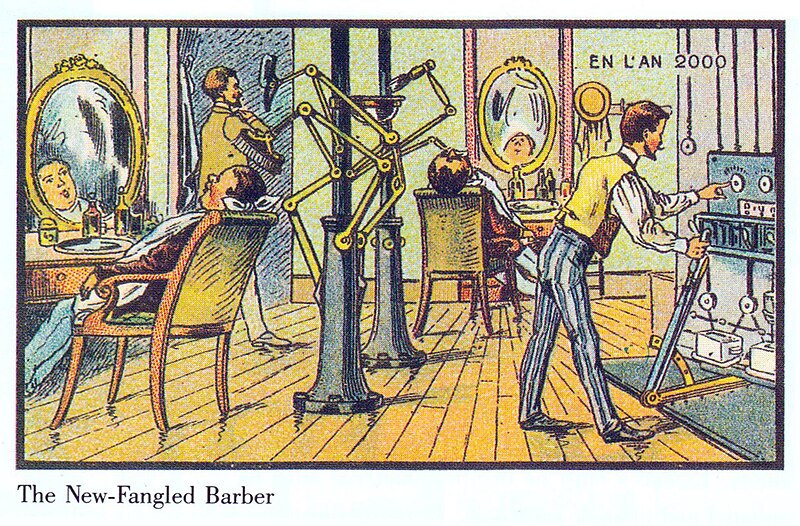
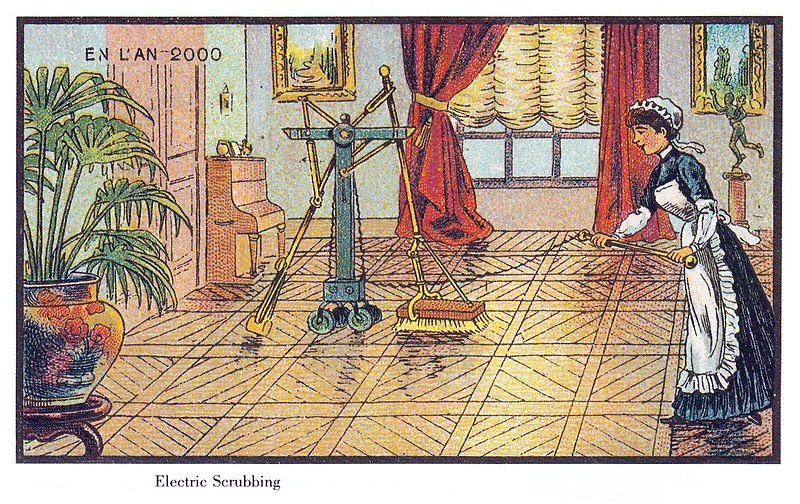
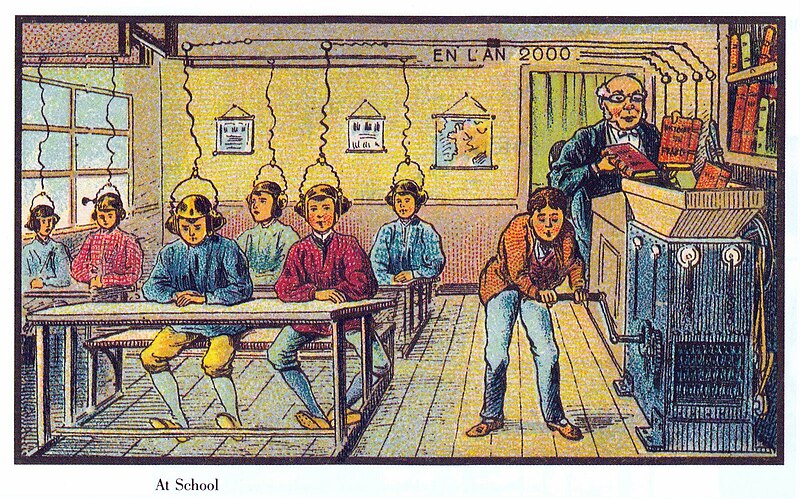
A 19th-Century Vision of the Year 2000 by mirena

A look Inside The World Of Chinese ‘Copy-Culture’ – Chinese artists make Van Gogh copies for a Dutch Bank. Every new client gets a Van Gogh painting, says the dealer. by mirena

And here is my stance on the matter – if they can copy Van Gogh – more power to them.  Copyright doesn’t have a place in art as all art is derivative. Picasso ripped aboriginal art, Van Gogh was inspired by Japanese woodcuts. The only takeaway here is that art carries power and presence. It only takes a corner of a sunflower to know it is Van Gogh, it takes an eye and a bit of nose to tell a Picasso, and it takes the corner of a Millennium Falcon to know it’s Star Wars. It is the strength of the artist’s ideas that overcomes us. And if there’s a place in China somewhere that makes good Van Goghs – the world is only better for it to be honest. A link directly to the Van Gogh’s copies in the timeline – I think they are pretty good:

http://www.youtube.com/watch?v=ZbZDO5y43ZU&t=4m34s

Enjoy in its entirety:

Huxley vs Orwell by mirena

This comic is based word from word on Neil Postman's book Amusing Ourselves to Death. As someone who is often amused by the internet I often fear our dependency on Google, our expectation for the clicking on buttons to deliver and our thirst for the waterfalls of information. I also rarely post depressing stuff as I like to keep positive and posted this simply on account of it being pretty amusing. What Orwell feared were those who would ban books. What Huxley feared was that there would be no reason to ban a book, for there would be no one who wanted to read one. Orwell feared those who would deprive us of information. Huxley feared those who would give us so much that we would be reduced to passivity and egotism. Orwell feared that the truth would be concealed from us. Huxley feared the truth would be drowned in a sea of irrelevance. Orwell feared we would become a captive culture. Huxley feared we would become a trivial culture, preoccupied with some equivalent of the feelies, the orgy porgy, and the centrifugal bumblepuppy. As Huxley remarked in Brave New World Revisited, the civil libertarians and rationalists who are ever on the alert to oppose tyranny "failed to take into account man's almost infinite appetite for distractions." In 1984, Orwell added, people are controlled by inflicting pain. In Brave New World, they are controlled by inflicting pleasure. In short, Orwell feared that what we fear will ruin us. Huxley feared that our desire will ruin us.

Huxley vs Orwell

The High Art of the Low Countries by mirena


A review of the first in the series in the Telegraph with an outline of the ideas covered in this documentary.  Artists  and their masterpieces covered: van Eyck, van der Weyden, Bosch, Bruegel, Rubens.

I remember seeing the Rubens and Brueghel exhibit at The Mauritshuis in The Hague in the Netherlands and it was one of the most magical experiences in paint I had ever seen.

Some of the art covered in the documentary: Ghent Altarpiece Garden of Earthly Delights


THE USES AND DISADVANTAGES OF SOCRATES by CHRISTOPHER ROWE by mirena

Abstract: Socrates was and is one of the most influential figures in the history of Western philosophy. Yet it remains an open question just what the real, historical Socrates stood for: he wrote nothing, and none even of our most ancient sources can probably be relied upon to give us anything like an accurate picture of his ideas and methods. As if to fill the gap, successive individual philosophers and philosophical traditions—from Plato to Nietzsche and beyond—construct a range of different Socrateses, to serve either as a model for emulation or as a target of attack. Nevertheless, the single most vivid picture of Socrates is that provided by Plato, who was his immediate philosophical successor, and who gave the character ‘Socrates’ the leading role in the majority of his fictional dialogues. What is this Socrates like, and does he have any use for us? http://research.ncl.ac.uk/histos/documents/1998.09RoweUsesandDisadvantagesofSocrates216229.pdf