Poet strolling by a marshy bank - ink on silk - and pretty much how I see the world by mirena

A very delicate painting I discovered and pretty much how I see the world except for me it is a clear lake, there are plants and living things in it and various wonders at various depths. Happy Thursday and Happy Memorial Day!

Poet strolling by a marshy bank. Artist:Liang Kai, Southern Song dynasty (1127–1279), ink on silk

Imagine this very delicate piece, a kinda of a gentle sack almost - has outlived all the rulers of the world and all of their castles. People from all walks of life stroll by it and observe it and this simple act gives people joy and power on the inside. One of the themes I often emphasize is that ideal objects, like paintings, poetry, great books, have the power to transform our rational and predictable world. It is an illusion that positions of power and objects of power have power, it is ideal objects, delicate things of delicate stature and subtle meanings that carry the longest and greatest punches to the mind.

dp154133


http://www.metmuseum.org/art/collection/search/40090


南宋 梁楷 澤畔行吟圖 團扇 Poet strolling by a marshy bank

Artist:
Liang Kai (Chinese, active early 13th century)
Period:
Southern Song dynasty (1127–1279)
Date:
early 13th century
Culture:
China
Medium:
Fan mounted as an album leaf; ink on silk
Dimensions:
Image: 9 x 9 9/16 in. (22.9 x 24.3 cm)
Classification:
Paintings
Credit Line:
Bequest of John M. Crawford Jr., 1988
Accession Number:
1989.363.14
On view at The Met Fifth Avenue in Gallery 213
Liang Kai served as a painter-in-attendance at the Song Imperial Painting Academy in Hangzhou from about 1201 to 1204; he relinquished that prestigious position to live and paint at a Chan (Zen in Japanese) Buddhist temple. Like his best-known paintings, preserved mostly in Japanese collections, this small landscape conveys a spiritual intensity. Under the great cliff, in the stillness of the landscape, a solitary figure meditates on the illusory world before him.

Free Art Books From the Guggenheim and others by mirena

  Guggenheim collection online:

https://archive.org/details/guggenheimmuseum

The Guggenheim has one of the largest collections of Kandinsky’s works in the world:

https://www.guggenheim.org/exhibition/kandinsky-3

The Metropolitan Museum of Art has hundreds of books available online:

http://www.metmuseum.org/art/metpublications/titles-with-full-text-online

The Getty’s virtual library:

http://www.getty.edu/publications/virtuallibrary/index.html

The meaning of a Flower by mirena

He is happiest who hath power to gather wisdom from a flowerIn my mind what is truly beautiful is not the beauty of the flower but our ability to comprehend it. Some time ago a visit to the Japanese Zen Gardens in Kyoto changed my life profoundly.. But it was because i brought my own meaning with me and it just blossomed there. "What is the meaning of a flower? Experience of life. The mind has to do with meaning. What's the meaning of a flower. There's the Zen story about a sermon of the Buddha in which he simply lifted a flower. There was only one man who gave him a sign with his eyes that he understood what was said. Now, the Buddha himself is called "the one thus come". There's no meaning. What's the meaning of the universe? What's the meaning of a flea? It's just there. We're so engaged in doing things to achieve purposes of outer value that we forget the inner value, the rapture that is associated with being alive, is what it's all about." Joseph Campbell .

img_2358img_2359

The Only Thing You Need to Get Good At .. remember rumble in the Bronx? here's late night reading in the Bronx by mirena

  Late night thinking in the Bronx:

http://www.raptitude.com/2017/03/only-thing-get-good-at/

The practice of Stoicism is new to me, but its central insight isn’t. Buddhism has an almost identical interpretation of the human condition: our lives are vastly harder than they need to be, but only because we grasp at more control than is actually available to us.

http://www.newyorker.com/magazine/2016/12/19/how-to-be-a-stoic

When I read that nobody should ever feel ashamed to be alone or to be in a crowd, I realized that I often felt ashamed of both of those things. Epictetus’ advice: when alone, “call it peace and liberty, and consider yourself the gods’ equal”; in a crowd, think of yourself as a guest at an enormous party, and celebrate the best you can.

http://classics.mit.edu/Epictetus/epicench.html

The Enchiridion

By Epictetus

Written 135 A.C.E.

Translated by Elizabeth Carter

1. Some things are in our control and others not. Things in our control are opinion, pursuit, desire, aversion, and, in a word, whatever are our own actions. Things not in our control are body, property, reputation, command, and, in one word, whatever are not our own actions.


and my favorite from Epictetus:

6. Don't be prideful with any excellence that is not your own. If a horse should be prideful and say, " I am handsome," it would be supportable. But when you are prideful, and say, " I have a handsome horse," know that you are proud of what is, in fact, only the good of the horse. What, then, is your own? Only your reaction to the appearances of things. Thus, when you behave conformably to nature in reaction to how things appear, you will be proud with reason; for you will take pride in some good of your own.

Ingredients of a Subway Car - Performance and Installation with Pen and Ink Drawings by mirena

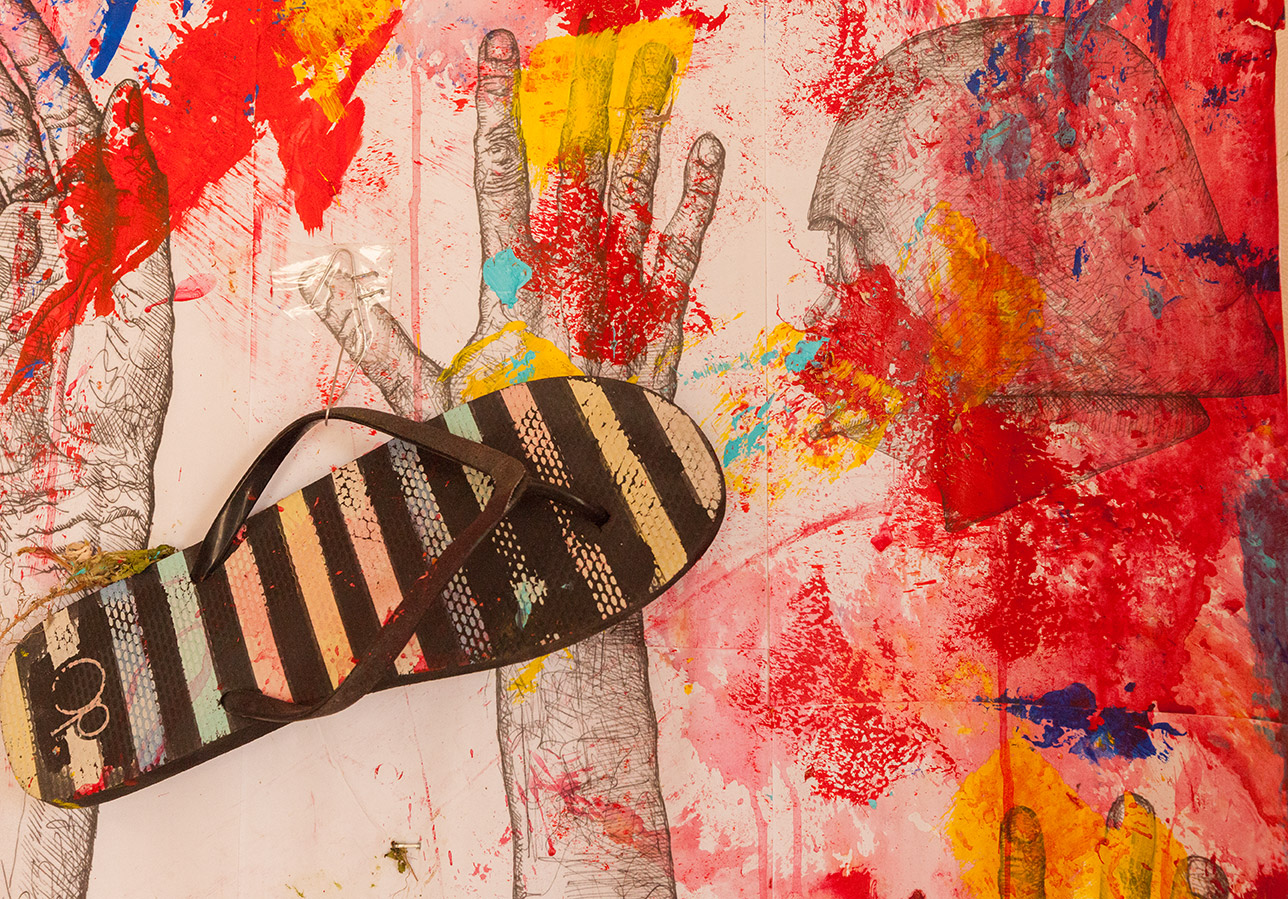
Ingredients of a Subway Car - Performance and Installation with Pen and Ink Drawings by NYC based artist Mirena Rhee Ingredients of a Subway Car - Performance and Installation with Pen and Ink Drawings, created over 4 hours with various objects of dubious character: apple peels, spinach, part of a juicer, toy cars, wood shavings, paint, ink, string, staple gun, carrots. includes painting with a belt, feet and an umbrella.


20 x 12  x 4 feet, 2017

Ingredients of a Subway Car - Performance and Installation with Pen and Ink Drawings by NYC based artist Mirena Rhee